




AI isn’t magic. It runs on information.
Say you open Copilot and ask, “What's our strategy for EV charging?" and you'll get a fluent, confident answer. Whether it's the right answer depends on something most of us never check: the information underneath it.
AI doesn’t create business knowledge. It finds what already exists in our documents, emails, Teams chats and/or SharePoint sites, then synthesize it to generate an answer. The quality of the answer can only be as good as the quality of the information behind it.
And when it's wrong, it's rarely obvious. A draft strategy quoted as approved. An outdated procedure presented as current. The answer sounds certain, so nobody questions it.
The brilliant new starter
Imagine you hire someone exceptionally capable. On their first day, you give them access to complex folders, multiple versions of the same file, and documents nobody has reviewed in years. Then, you ask them a business question.
They'll do their best. There's still a fair chance they'll come back with the wrong answer and sound completely sure of it.
AI works the same way. When information is hard to find, out of date or poorly maintained, AI inherits those problems. A lot of what we call "hallucinations" starts here. The AI isn't making things up for fun. It's working right with what we gave it.
Five simple questions worth asking
AI-ready information comes down to five simple questions. Think of these as five checks information needs to pass before AI can use it effectively.
1. Can AI find it? (Findable)
We've all seen a folder like this:
Final_v5, Final_v6, Final_v7, New_Final, Latest_Final
Which one is really approved and the final one? If you can't tell, AI can't either. A clear name, the right metadata providing business context, turn a guess into a proper answer.
2. Can AI rely on it? (Trusted)
Say a strategy document exists in four versions: one approved, three drafts. If nothing tells them apart, AI may quote a draft, and the reader has no way of knowing. Trusted information has one version everyone treats as the source of truth, reviewed regularly, with a clear status.
3. Can AI access it safely? (Secured)
AI follows the same permissions person using the AI do. If an HR salary report is open to the whole company, AI treats it as open to the whole company.
Content that stayed hidden by obscurity can now be surfaced in seconds. So, we don't loosen security to help AI work. We keep it in place so AI can work safely.
4. Who owns it? (Accountable)
Picture a critical operations guide whose owner left three years ago. Is it still accurate? Who checks it? Who should update it? Nobody knows.
The document still sits on the site, but in practice it's dead. Ownership is what keeps information alive.
5. How healthy is it? (Observable)
You can't fix what you can't see. Duplicates, outdated content, missing owners and compliance gaps don't announce themselves. They build up quietly until people stop trusting what they find. Once that happens, AI answers built on that content can't be trusted either.
Imagine learning that 40% of a site hasn't been touched in three years. That's the kind of signal that tells you where to act first.
Put together, the five questions give a simple test:
AI-ready information is easy to find, reliable, protected, owned and monitored.
What you can do this week
None of it needs fancy tools. It mostly comes down to habits.
- Name files so they mean something (Findable). "Retail Growth Strategy 2027 – Approved" beats "Final_v7" every time.
- Keep one master version (Trusted). Share a link instead of attaching a copy and delete duplicates when you find them.
- Check before you share (Secured). Validate the sensitivity label and who has access.
- Name an owner (Accountable). Make sure important content has an owner and is updated when the owner moves on or teams change.
- Speak up (Observable). Flag anything out of date and answer review requests when they land in your inbox.
Each habit takes little effort on its own. Across thousands of people, they change the information we all work with every day, and the information AI depends on.
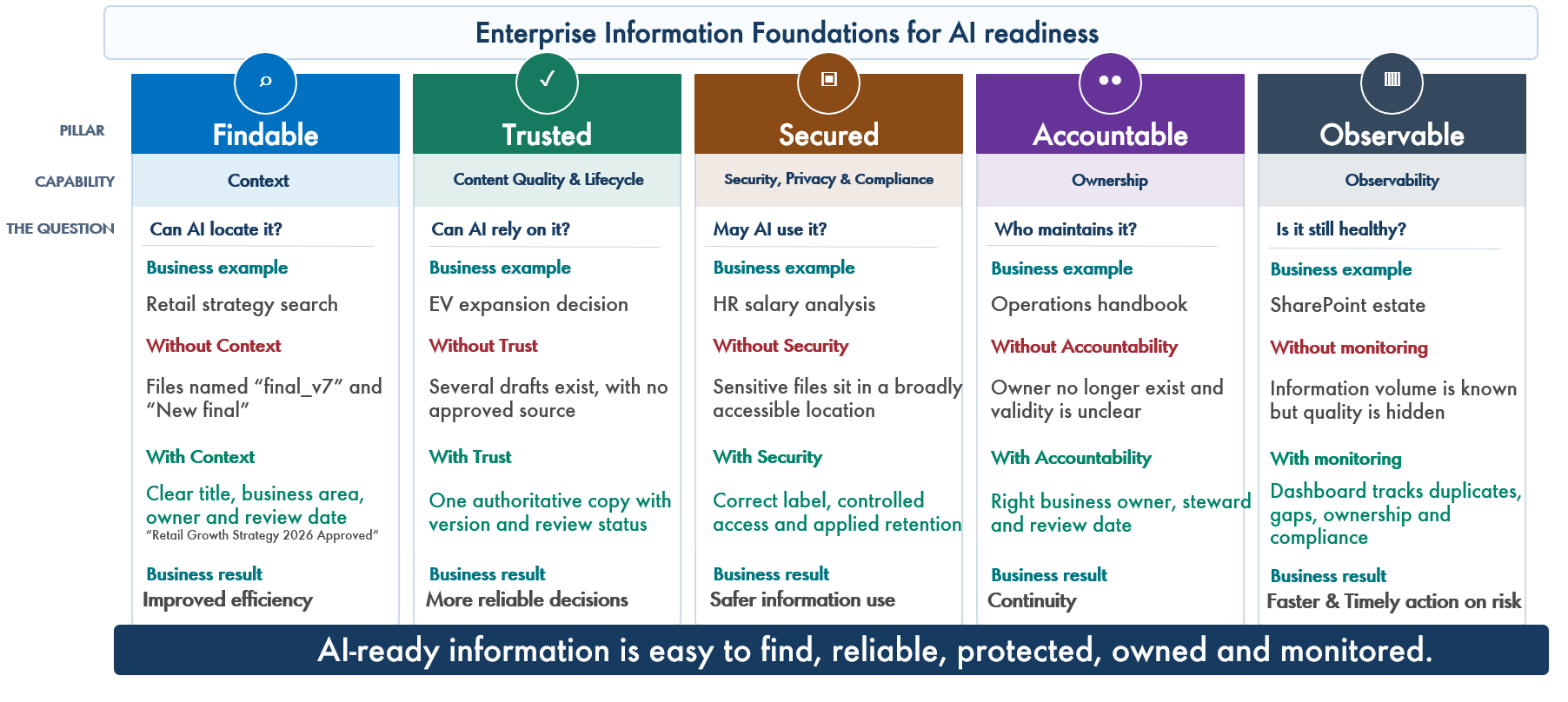
For IM professionals: from model to measurement
If you design or run information controls, the five pillars also work as an assessment model at site, site-group, business-area or enterprise level. For each pillar, ask what you can measure:
- Findable: % of content with meaningful titles and required metadata; is your metadata strategy fit for purpose; % of content in governed locations.
- Trusted: Level of duplication; share of content with a defined status and a review date that's being met.
- Secured: % share of sensitive content labelled; how much of it is shared with everyone.
- Accountable: Sites and libraries with an active named owner vs. orphaned.
- Observable: Volume of stale content, and whether the trend is rising or falling.
Three lessons we've learned:
- Start where AI is used most. Begin with high-traffic, high-value sites instead of trying to fix everything at once.
- Score it, then act on it. A simple score per pillar gives site owners something concrete to work on and lets leaders track progress.
- Share the load. EIM provides the controls, but managing information is everyone's job. Controls without habits won't stick, and habits without controls won't scale.
One last thought
We often assume AI readiness starts the day an AI tool goes live. It starts much earlier: every time someone creates a document, names a file, shares a folder, reviews content or assigns an owner.
So maybe we've been asking the wrong question. It isn't "Is our AI ready?"
It's "Is our information ready for AI?"
Better information helps people make better decisions today, and it helps AI give better answers tomorrow.