

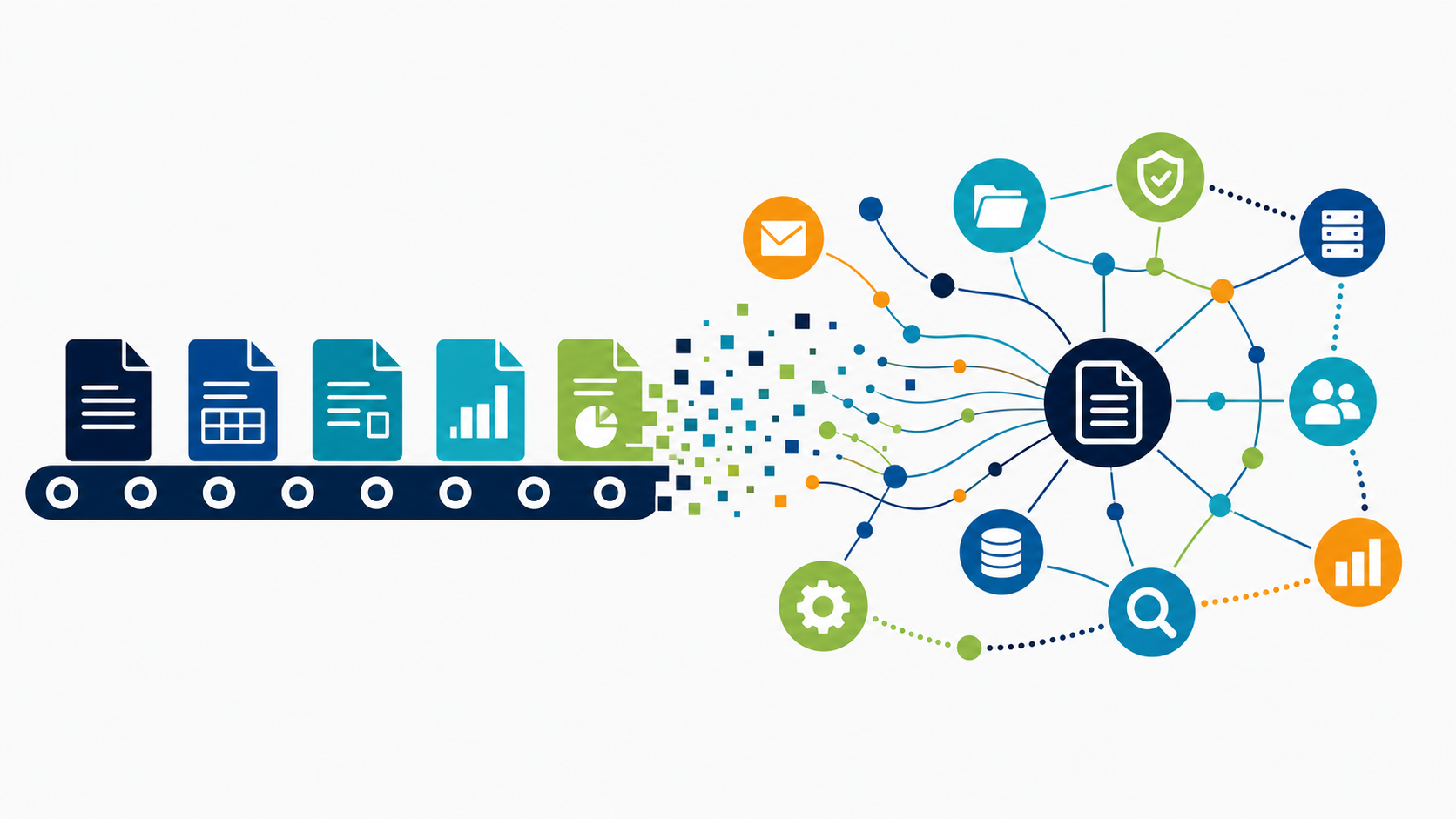


Earlier this week I found myself in a back and forth with a fellow (and very well decorated) professional in a LinkedIn Group about the Records Continuum Concept, and it's limits. The conversation re-ignited in me the first time I encountered the reference to this "new theory", which directly flew in the face of what I learnt and knew about the tried and tested Records Lifecycle Concept.
The audacity of it all at the time, which was about 10 years ago ruffled quite a few feathers of the folks who've championed our beloved profession!
In records management and archival science, few debates have endured as fiercely as the battle between the Records Lifecycle Model and the Records Continuum Model.
To outsiders, the disagreement may seem academic. To professionals in the field, however, the divide touches nearly every aspect of governance, accountability, digital preservation, archives, compliance, and institutional memory.
At its most dramatic, defenders of the traditional Records Lifecycle Model often treat continuum advocates as radicals attempting to dismantle decades of accepted archival practice.
And in many ways, they are.
The Traditional Standard: The Records Lifecycle Model
For much of the twentieth century, the Records Lifecycle Model dominated records management practice across governments, corporations, and institutions. The model is elegant because it is simple.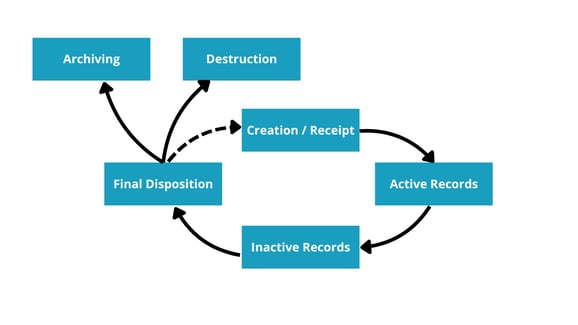
Records move through sequential stages:
- Creation
- Active use
- Semi-active storage
- Destruction or archival preservation
This approach reflects the realities of the paper era:
- physical storage limitations
- administrative handoffs
- retention scheduling
- clear distinctions between current and historical records
The lifecycle model established professional boundaries:
- records managers controlled active records
- archivists inherited historically valuable records later
The philosophy assumes records travel along a predictable path. Like a conveyor belt. For decades, this worked remarkably well.
Then the Digital World Broke the Conveyor Belt
Digital records exposed weaknesses in the lifecycle approach. Emails do not become “inactive” in the same way paper files do. Cloud documents are continuously edited. Databases evolve dynamically. Metadata changes constantly. Copies proliferate across systems.
The neat progression from active to inactive to archival began collapsing.
This is where the Records Continuum Model emerged as both a critique and a revolution.
The Records Continuum Model: The Pushback Begins
Developed largely through Australian archival scholarship, particularly through the work of Frank Upward and continuum theorists, the Records Continuum Model rejected the idea that records move through isolated stages.
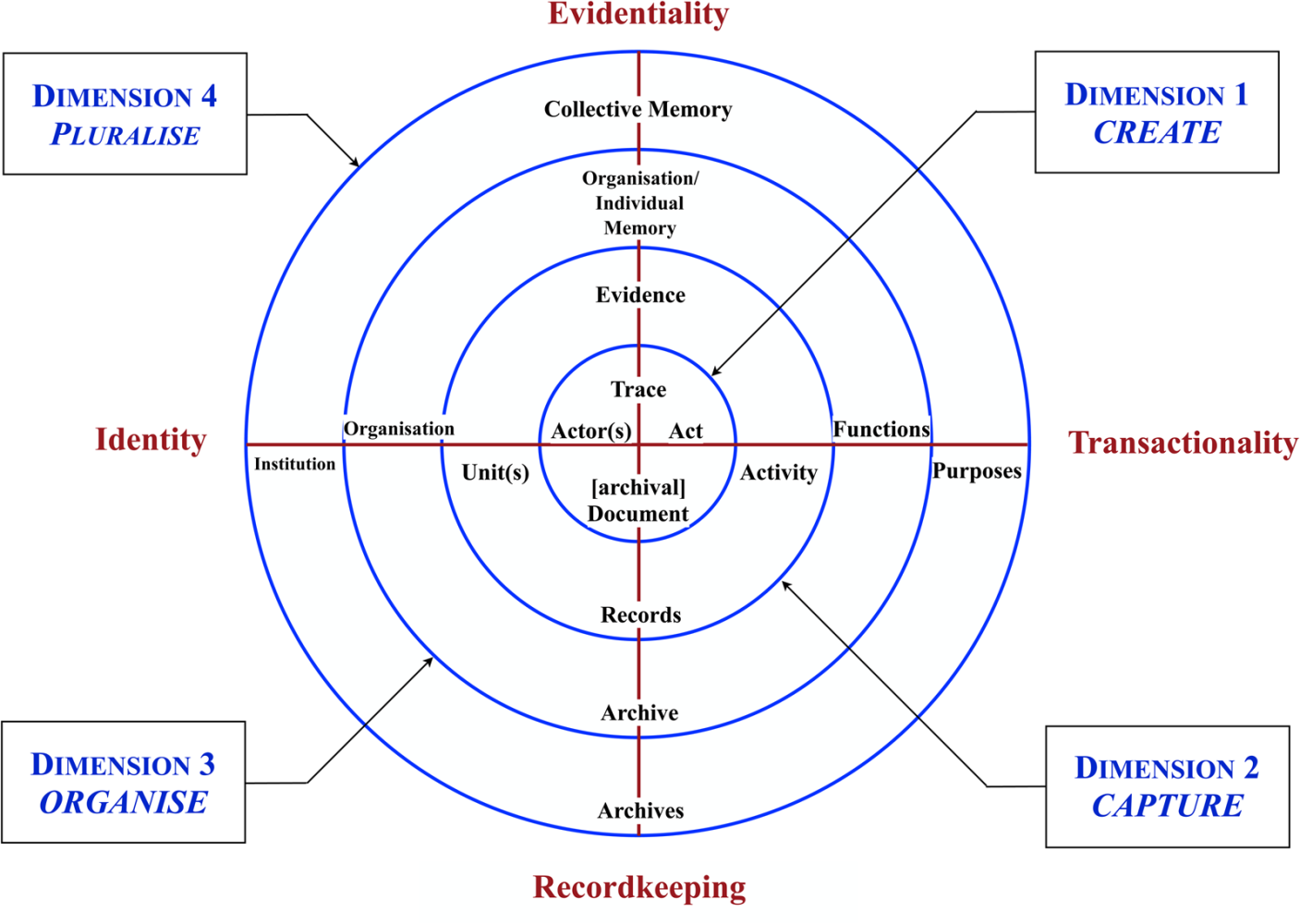
The Records Continuum (dimensions in blue, axes in red). (Reproduced from Upward 1996:273, 2005:203).
Instead, continuum thinking argues:
- records exist across multiple dimensions simultaneously
- archival value begins at creation
- records can serve administrative, legal, cultural, and historical functions at the same time
- recordkeeping should be embedded into systems design from the beginning
Rather than seeing records as objects moving down a timeline, the continuum views records as existing within interconnected networks of evidence, memory, governance, and social use.
The distinction may sound subtle. It is not.
The continuum model fundamentally challenges the architecture of traditional records management.
Why Lifecycle Defenders Resist
To many traditional practitioners, continuum theory can feel frustratingly abstract. The lifecycle model remains operationally powerful because organizations still need practical answers to practical questions:
- What do we keep?
- For how long?
- Who owns it?
- When can it be destroyed?
- How do we reduce storage costs and legal risk?
Retention schedules, disposal authorities, and compliance frameworks still rely heavily on lifecycle logic. From this perspective, continuum thinking can appear overly theoretical — more philosophical than administrative.
Critics argue that not every record deserves immediate archival consideration. A cafeteria receipt is not automatically a societal memory artifact. Others worry the continuum model dissolves the clear division of labor between archivists and records managers.
For institutions built around these structures, that is not merely theoretical disruption. It is organizational upheaval.
Why Continuum Advocates Believe the Lifecycle Model Is Obsolete
Continuum theorists counter that lifecycle thinking was built for a paper world that no longer exists. In modern digital environments:
- records are networked
- access is continuous
- systems are decentralized
- accountability requirements emerge immediately
- preservation concerns begin at creation
Waiting until records become “historical” is no longer viable. By the time archivists encounter poorly designed digital systems, authenticity, provenance, metadata, and evidential integrity may already be compromised.
Continuum thinking therefore insists that archivists, records managers, information architects, cybersecurity teams, and governance professionals must collaborate from the beginning.
This represents a major philosophical shift: Archives are no longer the end point. They are embedded within ongoing governance processes.
Why the Debate Still Matters
This is not just an academic argument. The model an organization adopts shapes:
- digital preservation strategy
- AI governance
- metadata architecture
- compliance frameworks
- public accountability
- legal defensibility
- access rights
- historical memory
As organizations confront:
- cloud computing
- distributed collaboration
- AI-generated records
- automated workflows
- real-time communication platforms
…the limitations of purely linear lifecycle thinking become increasingly visible.
The Real Lesson
The most important insight from this debate may be that neither model fully replaces the other. The lifecycle model excels at administration. The continuum model excels at explaining complexity.
One prioritizes order. The other prioritizes interconnectedness.
One emerged from paper bureaucracy. The other emerged from digital transformation.
Calling continuum theory a threat to convention is therefore both telling and a little ironic. It reminds us that records management is not simply about storage. It is about how societies define evidence, accountability, memory, and truth. And whenever foundational assumptions about evidence and memory are challenged, institutional convention rarely gives ground easily.
Final Thought
The future of records management will likely not belong entirely to either model. Instead, the profession is moving toward a synthesis:
- lifecycle discipline for operational governance
- continuum thinking for digital complexity and societal accountability
The organizations that succeed will not be those that cling rigidly to one doctrine. They will be the ones capable of understanding when records behave like linear assets — and when they behave like living systems. That is where the real value in records management may ultimately be found.