




The Headwinds Facing IG
Most of us know that Information Governance (IG) has been a popular term since the 1990’s when it was coined as a next big thing for Records Management. It has had success – adopted in number of different forms, including conferences, frameworks, the “Chief Information Governance Officer (CIGO)” certification and roles that include the term. But the headwinds have grown – Information Management along with Data Governance have for a long time created conflict with IG.
Now, with things like AI, Cybersecurity and Data Sovereignty gaining traction are we seeing IG getting eclipsed?
Not yet…
The Infrastructure Other Systems Depend On
Information Governance (IG) rarely reveals itself. It rarely makes it onto a strategy deck. But if you look at the defining technology and risk stories of this era — AI systems that are built on unreliable data, mergers that unravel because no one knows what to do with who owns what, sustainability disclosures that collapse under scrutiny, disinformation campaigns that outstrip the truth — the same absence keeps happening: a lack of disciplined, well-managed information.
IG is not a single function performing a single job. It’s the infrastructure other systems depend on, a countermeasure against emerging threats, a discipline tested most rigorously in times of change, and, increasingly, a source of tangible business value that needs to be proven rather than assumed.
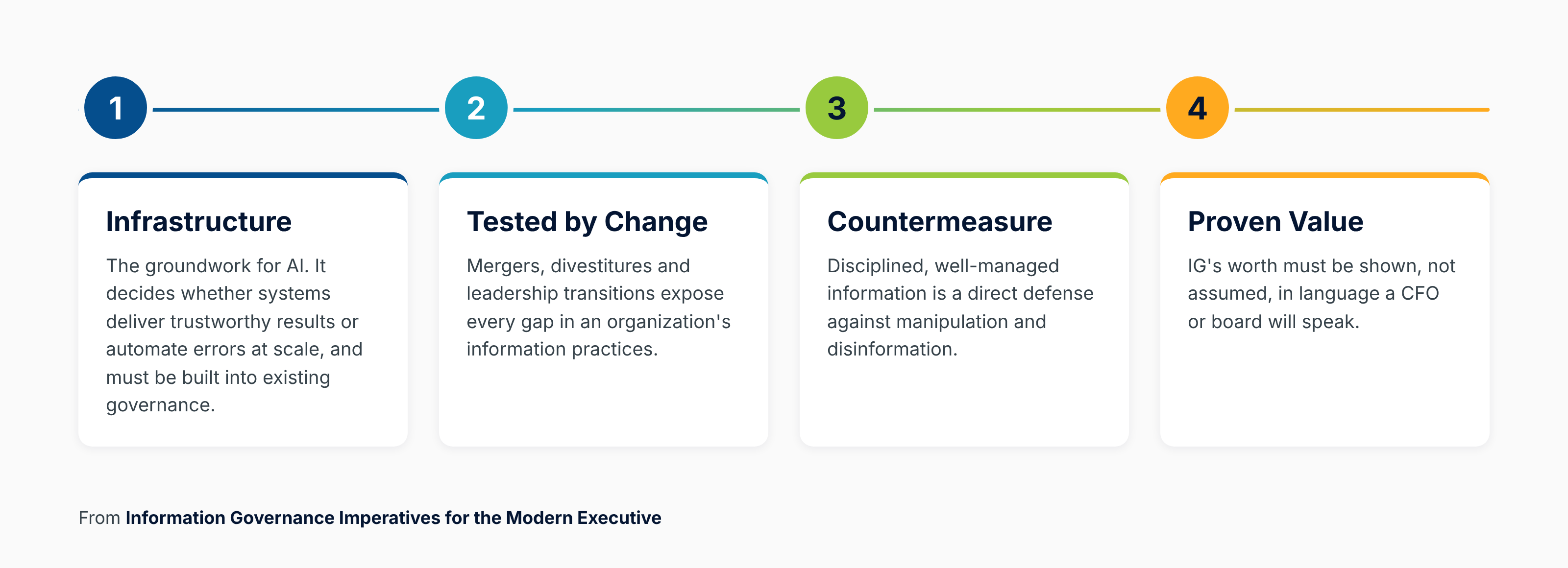
Four Stages of One Argument
These four elements are not separate stories; they are stages of one argument.
IG begins as the scaffolding for artificial intelligence—the very, very low-level groundwork that determines whether an AI system will produce trustworthy results or automatically automate errors at scale.
So if IG is infrastructure, it cannot be quarantined inside a separate AI ethics office; it has to be built into a governance system your organization already has.
Frameworks for Building IG Into What You Already Have
In practice, many organizations look to established frameworks to guide this integration. Actionable models such as ARMA’s Information Governance Implementation Model, DAMA-DMBOK (Data Management Body of Knowledge), COBIT (Control Objectives for Information and Related Technologies), ISO 15489 (Information and documentation—Records management), ISO 30300 (Management Systems for Records) and ISO 38500 (the International Standard for IT Governance) provide practical approaches to embedding IG into existing structures. These frameworks help clarify roles, responsibilities, and processes, making IG more tangible and actionable within different organizational contexts.
Under Pressure, and Beyond
That kind of structural argument is then tested under real pressure, nowhere more than in mergers, divestitures, and leadership transitions, where gaps in an organization’s information practices are impossible to hide. The discipline’s scope expands again into ESG and sustainability reporting, where the same practices of ownership, quality, lineage, and auditability that IG has always relied on to justify its claims to regulators, investors, and the public are now being asked to cover these areas. It also extends to information warfare, with governance serving as a direct countermeasure against manipulation and disinformation. And because all of this will not survive without funding, the argument comes down to the question every governance leader has to answer eventually: How do you prove, in language a CFO or a board will speak, that IG is worth the investment?
So IG isn’t going to fade away. But we, as practitioners, do need to step into new conversations, new domains and build that scaffolding.
Learn More
If you want to learn more, check out Information Governance Imperatives for the Modern Executive, available November 1st on Amazon or at https://rmgim.ca/book-store/.