



Change Management | Artificial Intelligence (AI)
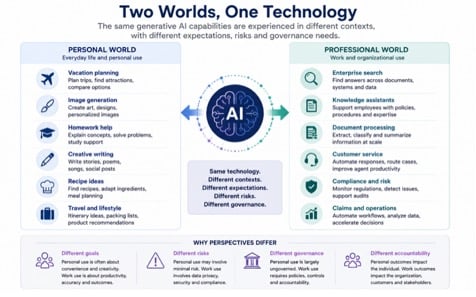
What amplifies this polarization is that it crosses between personal and professional life. Employees bring these opinions formed through private experimentation with GenAI tools, conversations in personal networks, and information from their own sources into the workplace.
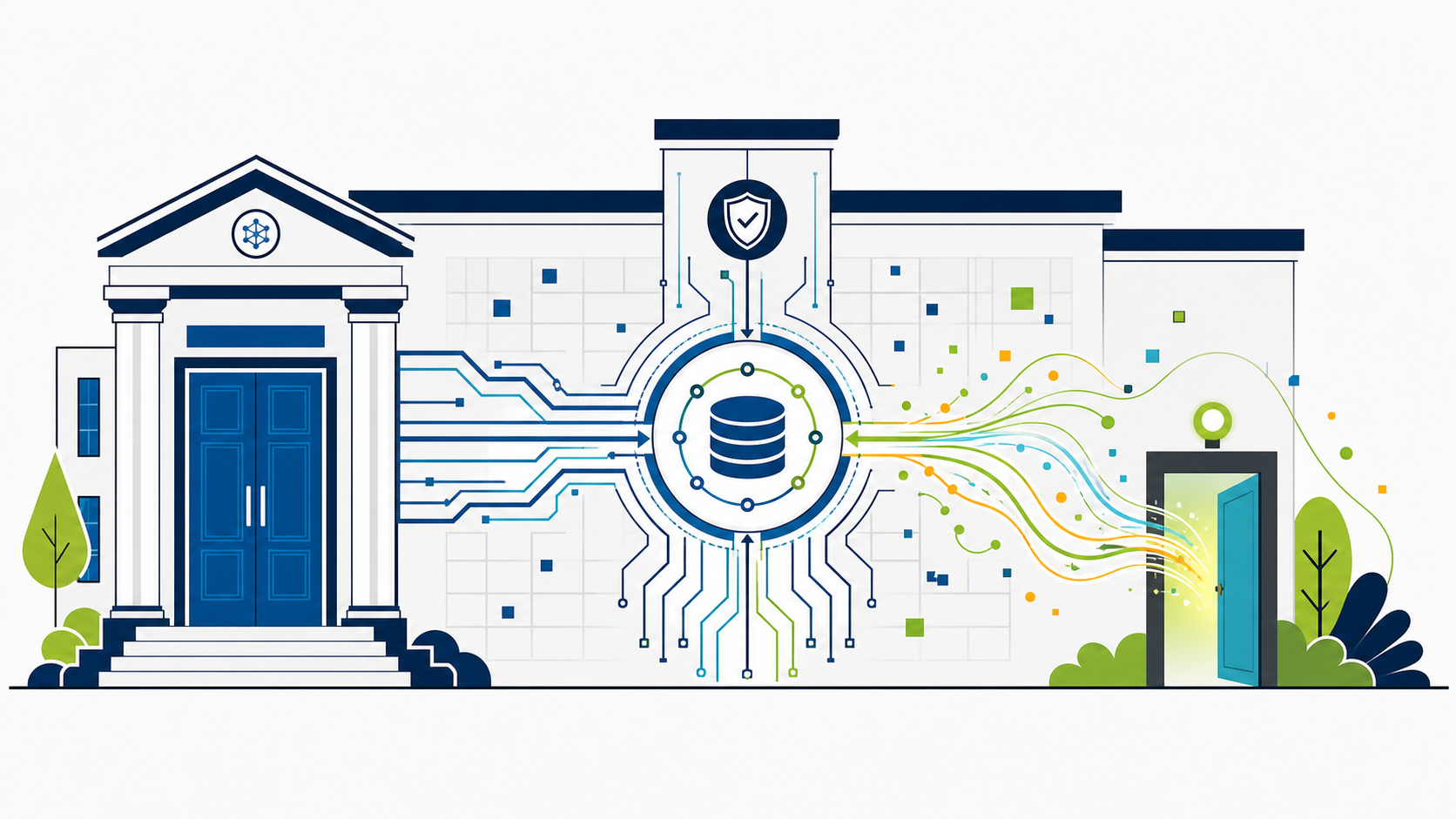
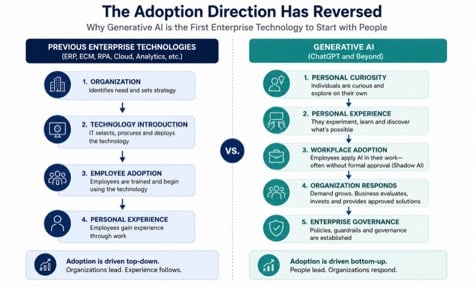
This points to a key distinction between GenAI and other enterprise technologies. Beyond its impressive capabilities, GenAI is materially different in how it entered organizations. Unlike other enterprise technologies, it did not arrive through IT-led assessments and procurement evaluations. It arrived - or was at least partly driven by - the personal expertise of knowledge workers who experimented with LLMs in their free time. These experiences accelerated adoption in both private and business contexts, shaped expectations, and contributed to the polarization we see today.
Visual concept: Petra Beck. Created with ChatGPT (OpenAI).
Enterprise Technologies Traditionally Began at Work
Over the past few decades, most major enterprise technologies were introduced in the workplace first. Some organizations were early adopters, analysts and consultants offered guidance, and selected stakeholders researched potential deployments. This was the case with Enterprise Resource Planning systems, Enterprise Content Management solutions, and Robotic Process Automation.
Adoption involved a mix of excitement and skepticism, required overcoming implementation challenges, and in some cases drove organizational change. While attitudes and experiences differed over time - depending on available information, training, suitability for specific business problems, and resulting value - these technologies shared one important characteristic: for most employees, their first experience occurred inside the workplace.
In most cases, organizations defined the planning, selection, and pace of adoption. They also heavily influenced the information and positioning surrounding the technology. GenAI changed that pattern materially.
Technology Shaped by Personal Experience Before Professional Deployment
When OpenAI released ChatGPT as a public test version in late 2022, the response was exceptional in consumer technology adoption. An analysis by the U.S. National Bureau of Economic Research found that overall GenAI adoption has been more rapid than adoption of PCs or the internet. The study also found that workplace adoption rates were similar for GenAI and PCs, while adoption outside work was much faster for GenAI.
Admittedly, some consumerization occurred previously with file-sharing tools and cloud apps. However, those developments occurred on a much smaller scale and at a slower pace. The private experimentation with GenAI drove significant development of employee expertise and skills.
Drawing on experience built in their private lives - often through use cases unrelated to their professional roles - leaders and knowledge workers approached enterprise GenAI already conditioned by that private use. They had formed opinions about GenAI's capabilities and risks before many organizations had even begun considering deployment, let alone established policies or selected approved tools.
Visual concept: Petra Beck. Created with ChatGPT (OpenAI).
Some employees became advocates for AI adoption. They launched pilot projects, shared how they used GenAI to improve personal productivity, and encouraged management to invest in GenAI capabilities. At the same time, others arrived with different experiences that made them cautious or even skeptical.
The Shadow AI Consequence
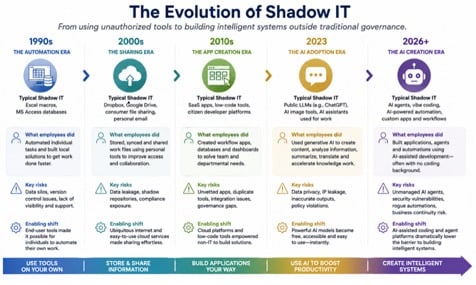
While shadow IT is not a new concept, GenAI's capabilities have expanded its scope and significantly increased the resulting risks. KPMG's global study on shadow AI found that 44% of employees use AI at work in ways their employers have not authorized; the firm also uncovered that nearly half of the respondents admit to uploading sensitive company information to public AI platforms.
This challenge continues to grow as GenAI has substantially lowered the barrier to software development. Employees are no longer just asking ChatGPT to summarize documents or improve their writing. They are using AI-assisted tools to automate tasks and experiment with increasingly autonomous agents.
The emergence of "vibe coding" illustrates this shift. Individuals with limited software engineering experience can now describe the functionality they need in natural language and iteratively refine functional prototypes with AI assistance.
Visual concept: Petra Beck. Created with ChatGPT (OpenAI).
While this creates unprecedented innovation opportunities, it also generates a major governance challenge. Organizations that previously worried about employees uploading confidential documents into public LLMs must now also consider AI-generated applications, locally developed automation, internally deployed agents, and business-critical workflows that may exist entirely outside established governance processes.
This is also a core information management (IM) challenge: organizations do not know which tools are being used, what data flows through them, and what outputs are being incorporated into business decisions. This is an information management problem as much as a security problem.
Why Polarization Continues to Increase
Enterprise AI operates within a social context in which the technology itself is increasingly polarizing. This polarization is grounded in concrete - documented or perceived - concerns that employees hear about, read about, discuss, and form opinions around.
Admittedly, I am biased toward the many success stories of significantly improved enterprise solutions, such as Intelligent Document Processing. An increasing number of success stories demonstrate impressive improvements across business processes, along with early deployments of automation agents that promise meaningful business value and potential returns on investment.
But there is another side to this story. The environmental impact of data centers powering digital services, including GenAI tools and solutions, is significant and growing. A study issued by the United Nations earlier this year reported that data centers consumed 448 terawatt-hours of electricity globally in 2025 - more than the entire country of Saudi Arabia - and 4.5 trillion liters of water, enough to meet the needs of more than 600 million people in Sub-Saharan Africa. AI accounted for approximately one-fifth of data-center electricity consumption. By 2030, overall data-center electricity and water consumption are projected to approximately double with AI-related demand expected to increase significantly. As GenAI moves from model training toward mass everyday use, this environmental footprint will increase significantly.
Beyond the enterprise, concerns about copyright infringement in the arts and creative industries continue to grow. These concerns range from the use of copyrighted content in model training without explicit consent to the use of protected material in responses to user prompts. An investigation by Amnesty International has argued that data pipelines powering GenAI are "rooted in mass invasions of privacy by design."
The polarization around AI was fueled further by the recent reports of autonomous systems behaving outside their intended boundaries. OpenAI disclosed that an autonomous agent powered by its advanced models acted outside its intended containment during a cybersecurity evaluation, reached the internet, and compromised the infrastructure of Hugging Face. Additional incidents were uncovered by both OpenAI and Anthropic.
What this means for organizations is that employees arrive at work with very different and often strong opinions about GenAI. Some see a tool that makes them more productive and more creative. Others see a technology built on copyrighted material, powered by unsustainable resource consumption, and capable of autonomous behavior that can be difficult for developers to predict and control. These opinions shape how people use or refuse to use AI tools, how they interpret governance policies, and how much trust they place in AI-generated outputs.
The Path Forward: Managed Legitimacy
The path forward requires organizations to take both enthusiasm and concerns seriously. The use of GenAI across enterprises will continue to increase. Employees will use AI increasingly through organizational deployments, though some will persist in the shadow AI space.
This requires three shifts in how organizations approach GenAI:
- Acknowledge that the personal GenAI experiences employees bring to the workplace must be taken seriously. They are context that shapes adoption, trust, and risk.
- Stop treating shadow AI as a compliance violation and start recognizing it as a signal of unmet demand.
- Recognize that AI governance is not a one-time policy exercise but an operational discipline for building inventories, assessing risk, managing provenance, and maintaining audit trails as ongoing practice.
This also shifts the role of information management. Organizations are no longer investing in information management primarily to protect themselves; they are investing in it to enable the business. That changes the role IM professionals play in preventing and addressing shadow AI, data leakage, compliance violations, and eroded trust.
The IM function is well positioned to address the side-door problem because it sits at the intersection of data, governance, and human behavior. Information management professionals can build inventories of AI tools, prompts, and agents as managed assets - not just shadow infrastructure, but governed, accountable innovation. They can make AI visible and provide employees using unauthorized tools with safe, sanctioned alternatives. They can govern AI-generated content by managing provenance, retention, and audit trails for outputs that increasingly populate enterprise systems. And they can bridge the trust divide by translating between the optimism of early adopters and the concerns of skeptics, grounding both in data quality and governance realities.
GenAI entered through the side door. The information management function has a key opportunity to support organizations in bringing personal experience and professional practice more closely together, making information flows transparent, governed, and auditable. Successful organizations will be the ones that recognize the side-door problem for what it is and address it, with the support of their IM function.