

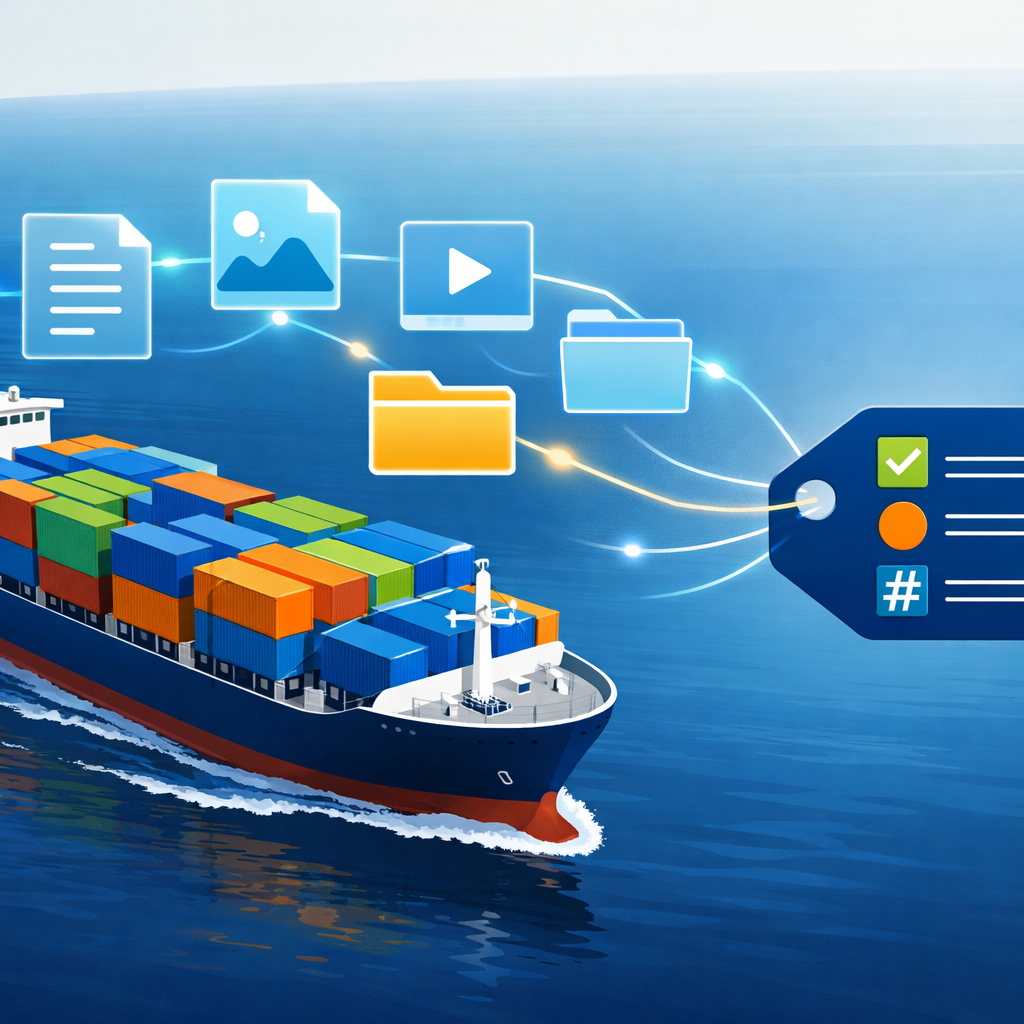


Intelligent Information Management (IIM) | Certified Information Professional (CIP)
If you work in data and information management, data and information governance, IT, or compliance, you've probably noticed that the certification landscape has gotten crowded. There's a credential for almost everything these days, which makes it a fair question to ask: why are there certifications specifically focused on information management? What makes information different enough to warrant its own body of knowledge, its own exam, its own professional community?
It starts with understanding what "information" actually means in this context. When information professionals use the term, we're generally referring to the data that lives outside a tidy tabular database: documents, official records, emails, contracts, policies, multimedia, and text of all kinds. This content makes up the vast majority of what organizations create and accumulate every day, and managing it well requires a different set of skills than managing a relational database.
Why Information Management Requires Distinct Expertise
That difference is exactly why dedicated certifications exist, including AIIM's Certified Information Professional (CIP), the IGP from ARMA, and others.
Managing information requires skills that are simply different from managing databases or data warehouses. It requires understanding how documents are created and captured, how metadata strategies work across systems, how classification schemes affect findability, how retention rules apply to content that doesn't live in a neat relational table, and how lifecycle decisions get made about things that accumulate legal and business significance over time.
The body of knowledge behind the CIP credential covers the full lifecycle of content, from capture through storage, active use, dissemination, archiving, and eventual disposition, all under a continuous layer of compliance and governance requirements. That lifecycle expertise is what separates an information professional from a data manager.
Data Is Content, but Content Is Not Data
Our past Board Chair and AIIM Fellow Karen Hobert captured this distinction in a graphic she created for Gartner using a container ship analogy, inspired by Marc Levinson's book The Box. It's one of the clearest explanations I've seen for why information and data are not the same thing.
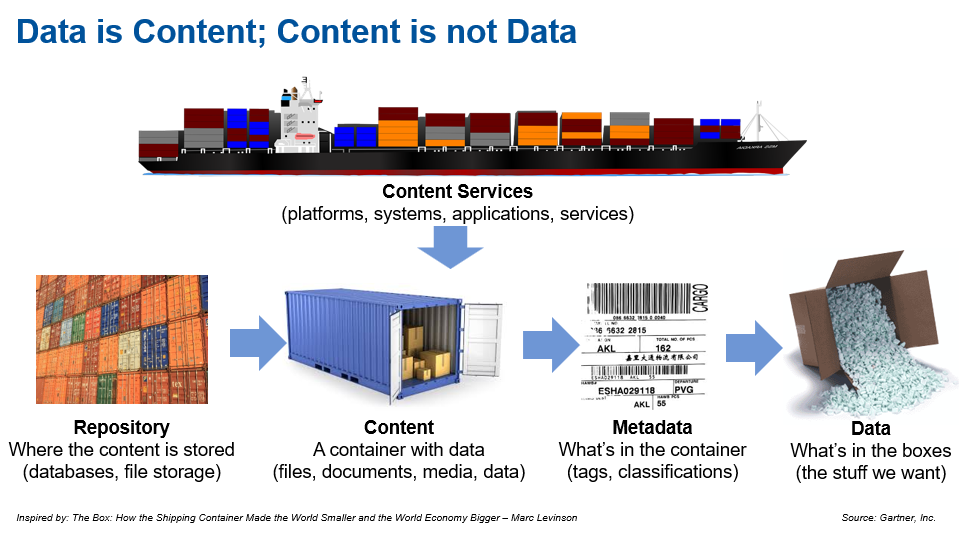
Think of information like a global shipping operation. Each ship is a different content services platform: a document management system, a records management system, an enterprise content management platform, and so on. These are the systems that move and manage everything. The stacks of containers loaded onto each ship are your information repository, where all your content is stored.
Each container is a single piece of content, say a contract or a policy memo. Open one up and you'll find it packed with boxes, and inside each box are goods or products for sale. Those goods are the data, the actual stuff you're after, nested several layers deep and waiting to be unpacked. The shipping label on the outside is your metadata, telling you what's inside and where it belongs before you ever open the doors.
Here's how the analogy maps:
- Each ship = a content services platform (a document management system, a records management system, an enterprise content management platform)
- The stacks of containers = your repository (where content is stored)
- Each container = a single piece of content (a contract, an email thread, a meeting transcript)
- The boxes inside = the discrete data points packed within that content
- The goods = the data itself, the stuff you actually want
- The shipping label = your metadata (what's inside, where it came from, where it belongs)
Hobert's key insight is that data is content, but content is not data. A customer record in a CRM is already data. It's sitting right there, structured and ready to use. A contract, a policy memo, an email thread, or a meeting transcript? Those are containers. The data is locked inside, waiting to be understood, classified, and put to work. That's the difference, and it's why content is so much harder to work with than the tidy rows and columns of structured data.
Analogies like the one Hobert shared can help explain the unique distinction and efforts behind information management. Executives don't need to understand the difference between tabular and non-tabular data. What they need to understand is that there is a data asset sitting inside their organization, that it has real business value, and that it also presents real risk if it isn't properly managed.
"AI Will Handle It" Is Not Information Strategy
I am often asked "can't AI just figure all of this out?" If we point a large language model at our SharePoint environment or our document repository, won't it extract what it needs?
The short answer is no, and the longer answer explains why information professionals are more relevant than ever.
AI systems are remarkably capable at recognizing patterns in content, but they lack the organizational context that makes information trustworthy and usable. They don't know which version of a policy is current and which is outdated. They can't tell whether a document was created for internal reference or is an official record with retention obligations. They won't flag that a file labeled "Final" is actually a draft that was never approved. Without humans in the loop they certainly can't make compliance decisions about what should be retained, what should be disposed of, and what needs to be preserved for legal or regulatory reasons.
What AI needs, and what it cannot supply on its own, is metadata. Not complete metadata for every field in every document, but the essential context that tells the system what content is most relevant, most accurate, and most appropriate to use for a given purpose. This is the shipping label in our analogy. Without that foundational layer, AI outputs are only as good as the chaos they're trained on or retrieving from. Garbage in, garbage out is not a new problem, and AI doesn't solve it.
Beyond accuracy, there's also the question of obligation. Organizations don't get to opt out of compliance requirements because they've deployed an AI tool. Records still need retention schedules. Sensitive personal data still needs access controls. Legal holds still need to be honored. Regulatory requirements don't have an AI exception clause. This means you still need qualified information professionals to ensure compliance.
Why We Need a Certification for Information Professionals
Your organization's content represents years, sometimes decades, of accumulated knowledge, decisions, relationships, and institutional memory. It's an asset. Leaving information disorganized, mislabeled, duplicated, or inaccessible is a compliance risk and a waste of something valuable.
At a moment when organizations are investing heavily in AI to become more data-driven and more efficient, the information sitting in your repositories and collaboration platforms is precisely what those AI systems need to work well. The professionals who know how to get that content in order, who understand what's really in the box before the AI opens it provide a strategic function.
AIIM created the CIP to recognize information professionals who have proven they have the skills to protect and manage information and develop organization-wide strategies based on established methodologies and industry best practices.
If you are ready to invest in yourself or the professionals managing one of your organization's most valuable assets (i.e., data), I encourage you to explore taking the CIP exam today. Check your readiness by taking our free 100-question practice exam.
Note: we are in the process of updating the CIP. A new version is expected in early 2027, making this a perfect time to take the exam before it changes.